
Hanwha SPE-1630 16-Channel Video Encoder — Bridge Large Analog CCTV Fleets to Modern IP NVRs
Model / Series: SPE-1630
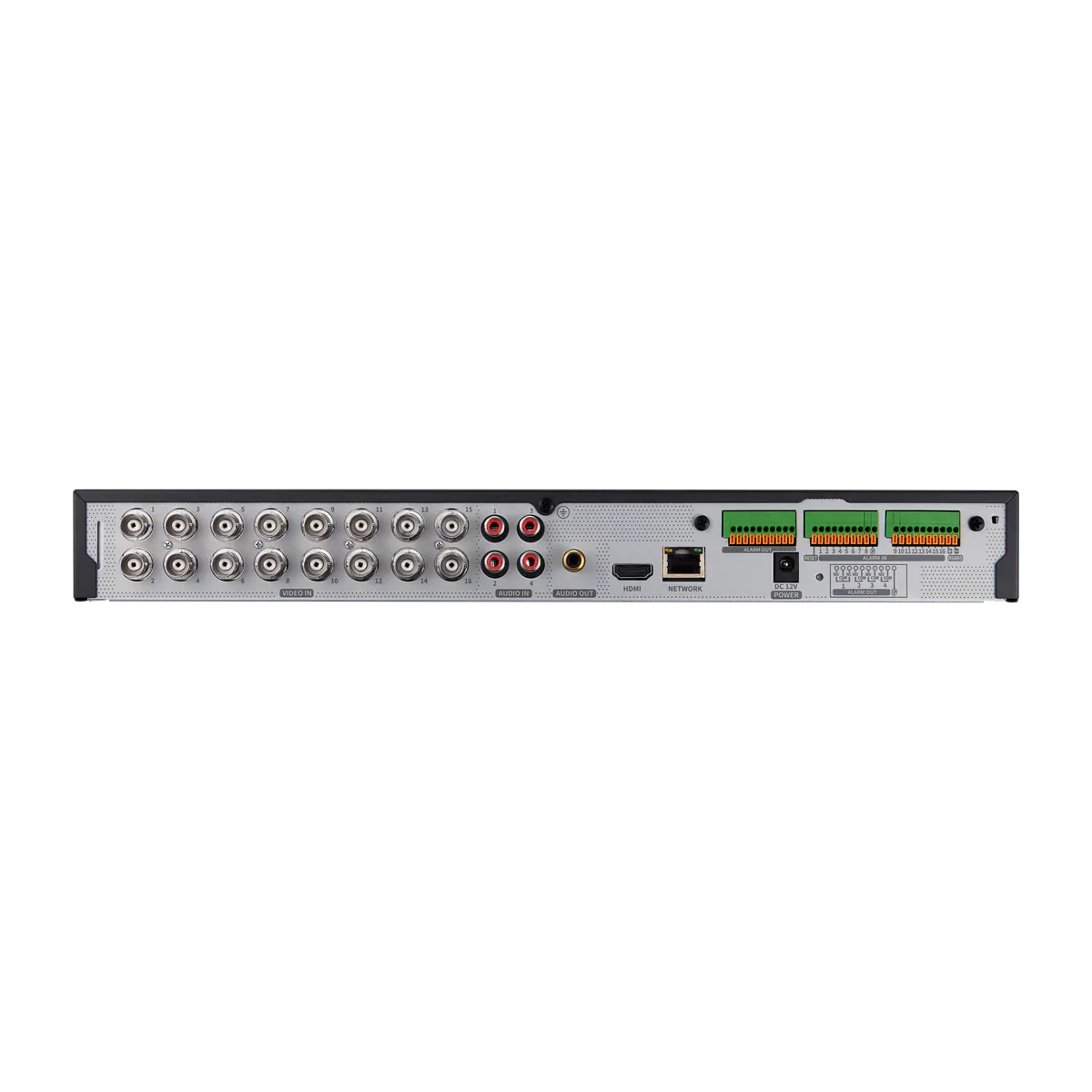
The Hanwha SPE-1630 is a 16-channel rackmount hybrid video encoder that converts AHD, CVI, TVI, and CVBS analog cameras (up to 5MP) into H.265 / H.264 IP streams. Auto-detects analog format per channel, gigabit network, ONVIF Profile S, HDMI 16-multi output, 4 audio inputs, 16 alarm inputs — ideal for whole-building or multi-floor analog-to-IP migrations in Chicago commercial buildings, condos, schools, and retail centers. TAA-compliant variant: SPE-1630/KUS.
$1,375 MSRP · equipment only
Sold by order — most of these go in as part of an install, but we'll sell the hardware outright too. Availability, lead times, and project pricing: ask our manager when you request a quote.
We don't just ship boxes — this goes in as part of our security camera installation in Chicago work. From the Loop to Rogers Park — see our security work across Chicago.
Specifications
- SKU / Part Number
- SPE-1630
- Brand
- Hanwha Vision
- Model
- SPE-1630
- Series
- Wisenet
- Type
- 16-Channel Hybrid Video Encoder (analog → IP, rackmount)
- Video Inputs
- 16 × BNC, 1.0 Vp-p / 75 Ω composite (NTSC/PAL)
- Supported Analog Formats
- CVBS, AHD, CVI, TVI — auto-detected per channel
- Max Analog Input Resolution
- 5MP per channel (also 4MP, 1080p, 720p, WD1, 4CIF, CIF)
- Video Output
- 1 × HDMI (16-multi image, 1920 × 1080)
- Video Compression
- H.265 / H.264 (Main / Baseline / High) / MJPEG
- Max Frame Rate per Channel
- 5MP: 12 fps · 4MP: 15 fps · 1080p / 720p / WD1 / 4CIF / CIF: 30 fps NTSC / 25 fps PAL
- Streaming
- Multi-streaming, up to 3 profiles per channel
- Audio Compression
- G.711 µ-law
- Audio I/O
- 4 line input / 1 line output
- Alarm I/O
- 16 input / 4 output (1 NO/COM/NC, 3 NO/COM)
- Network
- 1 × RJ-45 10/100/1000 BASE-T (Gigabit)
- Protocols
- ONVIF Profile S support
- Power Input
- DC 12 V / 5 A
- Power Consumption
- Max 20.0 W (12 V, 1.67 A)
- Operating Temperature
- −10 °C to +50 °C (+14 °F to +122 °F)
- Operating Humidity
- 20% to 80% RH
- Dimensions
- (W) 370.0 × (H) 44.0 × (D) 320.0 mm — 1U rackmount form factor
- Weight
- 2.32 kg (5.115 lb)
- Mounting
- Rack mount brackets included (1U / 19-inch rack)
- TAA / NDAA Compliance
- TAA-compliant variant: SPE-1630/KUS
Best Fit & Recommended For
Hanwha SPE-1630 — 16-Channel Rackmount Video Encoder for Whole-Building Migrations
The Hanwha SPE-1630 is a 1U rackmount 16-channel hybrid video encoder from Hanwha Vision’s Wisenet line — designed for whole-building or multi-floor analog-to-IP migrations where 16+ legacy analog cameras need to be consolidated at a single rack location. Each of the 16 BNC inputs auto-detects CVBS, AHD, CVI, or TVI analog format and re-encodes the signal as H.265, H.264, or MJPEG IP streams ready for any ONVIF Profile S NVR or VMS. With gigabit network, HDMI 16-multi-image output, 4 audio inputs + 1 audio output, 16 alarm inputs + 4 alarm outputs, and a TAA-compliant variant (SPE-1630/KUS) for federally funded projects, the SPE-1630 is one of the cleanest large-scale analog-to-IP migration tools in Hanwha’s catalog.
For Chicago condo buildings, school districts, hotel properties, healthcare facilities, retail centers, and commercial buildings with extensive legacy coax CCTV infrastructure, the SPE-1630 is the right specification when the migration scope is 16+ cameras consolidated at one location.
Whole-Building Migration in One Rack Position
Most Chicago commercial buildings built or last renovated before about 2018 have analog CCTV with BNC connectors and coax in walls / risers. For smaller properties with 4 or 8 cameras, the SPE-420 (4-channel desktop / shelf encoder) is the right pick. For larger properties with 16+ cameras, consolidating into a single rackmount encoder dramatically simplifies the project:
| Cost factor | 4× SPE-420 (16 cameras) | 1× SPE-1630 (16 cameras) |
|---|---|---|
| Cable runs to encoder | 16 individual coax + 4 PoE | 16 coax to one device + 1 power + 1 network |
| Rack space | 4 desktop / shelf units | 1U rackmount |
| PoE switch ports | 4 | 0 (uses dedicated 12 V supply) |
| Network IP addresses | 4 | 1 |
| NVR / VMS device count | 4 ONVIF devices, 16 channels | 1 ONVIF device, 16 channels |
| Management | 4 separate config sessions | 1 unified configuration |
For multi-floor or whole-building migrations, the rack-consolidated approach is faster to install, easier to maintain, and uses less network and rack overhead.
Multi-Format Compatibility (AHD / TVI / CVI / CVBS)
Each of the 16 BNC inputs auto-detects the analog format independently. This matters for real-world Chicago commercial buildings where the analog camera fleet often includes a mix of formats accumulated over years of phased upgrades — some early CVBS cameras still working alongside newer AHD or TVI replacements, some channels feeding from CVI hybrid recorders. The SPE-1630 reads them all on the same encoder.
| Format | Common Sources |
|---|---|
| CVBS | Legacy 480p analog cameras, older system additions |
| AHD | Hikvision, Dahua, Hanwha, LTS, generic AHD installations |
| TVI | Hikvision Turbo HD, LTS, Speco |
| CVI | Dahua, Lorex, generic CVI installations |
Gigabit Network — Required for 16-Channel Streaming
16 channels of H.265 video at full frame rate generates significantly more aggregate bitrate than a 4-channel encoder. The SPE-1630’s 10/100/1000 BASE-T (gigabit) network interface eliminates network bottleneck for the full 16-channel stream load — particularly important when running multiple stream profiles per channel (one high-quality profile to NVR, lower-bitrate profile to remote viewing).
Specifying gigabit network infrastructure end-to-end (from encoder to switch to NVR) is part of any SPE-1630 deployment plan. We size the switch uplink and NVR network port for the full encoder bitrate during commissioning.
HDMI 16-Multi-Image Output — Local Monitor Wall
The SPE-1630 includes a single HDMI output that displays all 16 channels in a multi-image grid at 1920 × 1080 — useful for local monitor wall installations at the IT closet or guard desk where the operator wants direct visibility of all 16 channels without an NVR client.
Audio + Alarm I/O — Building Integration
- Audio: 4 line inputs (G.711 µ-law) and 1 line output — useful at properties with intercom integration, PA system audio capture, or concierge / front-desk audio coverage
- Alarm I/O: 16 inputs and 4 outputs — door contact integration, panic-button triggers, relay output to lighting / sirens. The 16 alarm inputs match the channel count, so each camera channel can have an associated trigger
Indoor Rack Mount Only
The SPE-1630’s −10 °C to +50 °C operating range and 1U rackmount form factor mean it lives in a conditioned indoor space — IT closet, telecom room, equipment rack in the building’s main electrical / mechanical room. The cameras themselves can be outdoor-rated (the analog signal travels over coax to the encoder location); the encoder must stay indoors.
Pairing With Analog Cameras and Modern NVRs
For complete legacy CCTV migrations, we typically specify the SPE-1630 alongside Hanwha’s analog HD camera replacements when failing analog cameras need to be replaced as part of the migration:
- Hanwha ACE-8020R — 5MP analog HD outdoor IR dome (replacement for failing legacy analog domes)
- Hanwha ACO-8020R — 5MP analog HD outdoor IR bullet (perimeter and pole-mount positions)
- Hanwha ACV-8081R — 5MP analog HD vandal dome with motorized varifocal (premium analog positions)
The SPE-1630 outputs to a Hanwha Wisenet NVR or any ONVIF-compatible NVR (Avigilon, Genetec, Milestone, Exacq).
TAA / NDAA — the /KUS Variant
For federally funded Chicago projects, Hanwha publishes the TAA-compliant variant SPE-1630/KUS. The /KUS suffix denotes the TAA-compliant supply chain meeting Trade Agreements Act and NDAA Section 889 requirements. For HUD-funded housing, federally funded schools, GSA office space, federal courthouses, federal transit projects — we specify the /KUS variant on the bid.
Professional 16-Channel Migration by Vidimost in Chicago
Vidimost LLC handles whole-building and multi-floor analog-to-IP migration projects across the city of Chicago — downtown to the neighborhood corridors, and downtown Chicago. The SPE-1630 is our standard pick for projects with 16+ analog cameras consolidating at one rack location.
Our scope on a typical project includes existing-system audit (mapping all analog cameras, their formats, coax run conditions, and current DVR configuration), encoder rack mounting, coax-to-encoder cable management with neat 16-input termination and per-channel labeling, gigabit network and switch sizing, NVR / VMS commissioning, ONVIF integration with stream tuning per channel, motion and alarm event configuration, and property manager training. For phased migrations across multiple buildings, we plan the rollout sequence to minimize downtime at each location.
Contact us for a free site walkthrough and quote.
Frequently Installed Together
Hanwha Vision
Hanwha SPE-420
The Hanwha SPE-420 is a 4-channel hybrid video encoder that converts AHD, CVI, TVI, and CVBS analog cameras (up to 5MP) into H.265 / H.264 IP streams. Auto-detects analog format per channel, supports ONVIF Profile S, and powers from PoE — ideal for phased analog-to-IP migrations in Chicago commercial buildings and HOAs with existing coax wiring.
View →Hanwha Vision
Hanwha ACE-8020R
5MP analog HD outdoor dome for coax CCTV — AHD, TVI, CVI, or CVBS out, 20 m IR, IP67. Drop-in swap for a dying analog camera.
View →Hanwha Vision
Hanwha ACO-8020R
The Hanwha ACO-8020R is a 5MP analog HD outdoor IR bullet camera with selectable AHD / TVI / CVI / CVBS output, fixed 3.6 mm F1.6 lens, 20 m built-in IR, and IP67 / IK10 housing. The bullet companion to the ACE-8020R dome — designed for coax-based CCTV systems and analog camera replacements in Chicago commercial buildings, retail, and HOA properties.
View →Hanwha Vision
Hanwha ACV-8081R
The Hanwha ACV-8081R is a 5MP analog HD outdoor IR vandal dome with a 3.5–10.5 mm motorized varifocal lens (3×), 25 m built-in IR, IP66 / IK10 housing, and selectable AHD / TVI / CVI / CVBS output. Designed for coax-based CCTV systems where remote-adjustable framing matters — Chicago commercial buildings, retail centers, and condos with existing analog DVR infrastructure.
View →