
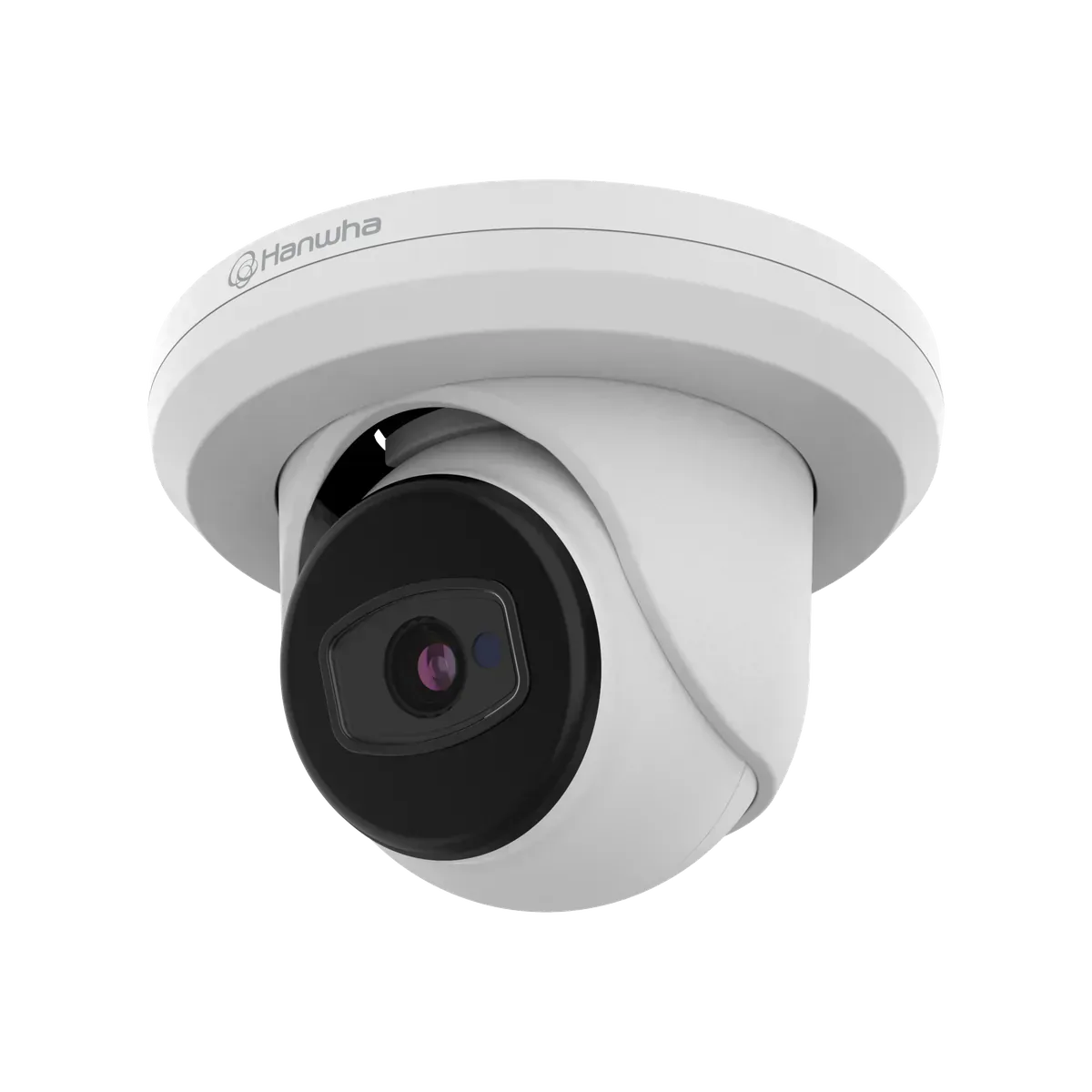
Hanwha ACE-8020R 5MP Analog HD Outdoor IR Dome Camera — AHD / TVI / CVI / CVBS for Coax CCTV
Model / Series: ACE-8020R
5MP analog HD outdoor dome for coax CCTV — AHD, TVI, CVI, or CVBS out, 20 m IR, IP67. Drop-in swap for a dying analog camera.
$120 MSRP · equipment only
Sold by order — most of these go in as part of an install, but we'll sell the hardware outright too. Availability, lead times, and project pricing: ask our manager when you request a quote.
We don't just ship boxes — this goes in as part of our security camera installation in Chicago work. City building? See our Chicago, IL service area.
Specifications
- SKU / Part Number
- ACE-8020R
- Brand
- Hanwha Vision
- Model
- ACE-8020R
- Series
- Wisenet HD+ (Analog HD)
- Camera Type
- Analog HD outdoor IR dome (AHD / TVI / CVI / CVBS — selectable)
- Image Sensor
- 1/2.5" CMOS
- Resolution
- 5MP (2592 × 1944) and 4MP (2560 × 1440)
- Max Frame Rate
- Max 30 fps · 5MP: max 20 fps · CVI mode: up to 4MP
- Lens
- 3.6 mm fixed focal
- Maximum Aperture
- F1.6
- Field of View
- Horizontal 83.9° / Vertical 63.4° / Diagonal 104°
- Minimum Object Distance
- 0.8 m (2.62 ft)
- Day/Night
- Auto (mechanical IR cut filter / ICR)
- Minimum Illumination (Color)
- 0.4 lux (F1.6, 1/30 s)
- Minimum Illumination (B/W)
- 0 lux (IR LED on)
- IR Illumination
- Built-in IR LED — viewable distance up to 20 m (66 ft)
- Video Output
- BNC — AHD / TVI / CVI / CVBS selectable
- Coaxial Control Protocol
- ACP (AHD), TCP (TVI), CCP (CVI)
- Transmission Distance
- Up to 300 m / 5C2V coax (extended range up to 500 m per Hanwha datasheet)
- Power Input
- 12 V DC
- Power Consumption
- Max 5.4 W, typical 4.3 W
- Operating Temperature
- −30 °C to +55 °C (−22 °F to +131 °F)
- Operating Humidity
- 0–90% RH
- Environmental Protection
- IP67 (weatherproof — dust-tight and immersion-resistant)
- Impact Resistance
- IK10 (vandal-resistant)
- Dimensions
- Ø 120 × 82 mm (Ø 4.72 × 3.23 in)
- Weight
- 410 g (0.90 lb)
- TAA / NDAA Compliance
- TAA-compliant variant: ACE-8020R/KEX
- Audio / Edge Storage / Network / ONVIF / Edge Analytics
- Not applicable — analog coax camera
Best Fit & Recommended For
Hanwha ACE-8020R — 5MP Analog HD Outdoor IR Dome for Coax-Based CCTV
The Hanwha ACE-8020R is a compact 5MP analog HD outdoor IR dome camera from Hanwha Vision’s Wisenet HD+ line — Hanwha’s analog camera family designed for coax-cabled CCTV systems. The ACE-8020R outputs over a single BNC connector with four selectable analog formats (AHD / TVI / CVI / CVBS), runs from 12 V DC, and includes a fixed 3.6 mm F1.6 lens with 20 m built-in IR. The housing is IP67 weatherproof and IK10 vandal-rated, and a TAA-compliant variant (ACE-8020R/KEX) is available where the bid requires it.
For Chicago commercial buildings, condos, retail centers, and HOA properties that still run on coax-based analog CCTV — which is most older buildings in this market — the ACE-8020R is one of the cleanest options for replacing failing analog cameras without forcing an entire system rebuild.
When the ACE-8020R Is the Right Choice
Most Chicago commercial buildings built or last renovated before about 2018 have analog CCTV: BNC connectors, RG-59 or RG-6 coax in walls and risers, and a DVR somewhere in the IT closet. The cameras themselves often still produce a usable image — but cameras fail over time, and when one does, the question becomes: replace it with another analog camera, or use the failure as a trigger to rebuild the whole system on IP?
The honest answer depends on the building, the budget, and the long-term plan. The ACE-8020R is the right call when:
- The existing analog DVR is still working and the owner is not ready to replace it — drop in a new ACE-8020R, configure the analog format to match the DVR, and the system is back online in an hour
- The coax runs are in good condition and re-pulling Cat6 would be disruptive — common in older condo and office buildings where re-cabling means tearing into finished walls, ceilings, and risers
- The project budget is constrained — analog HD cameras cost meaningfully less than IP cameras, and a full system rebuild may not fit this year’s capital budget
- You are running a phased migration — install analog cameras now, bridge to a modern IP NVR via the Hanwha SPE-420 encoder, and replace the cameras with native IP cameras later as budget allows
For new buildings or full system rebuilds, native IP is almost always the better long-term choice — better image quality, more analytics, easier remote access, simpler scale-up. But not every project is a new build, and the ACE-8020R fills a specific and common need cleanly.
Multi-Format Compatibility (AHD / TVI / CVI / CVBS)
The ACE-8020R’s most useful feature for replacement projects is its multi-format output. The camera supports four selectable analog formats over its single BNC connector:
| Format | Full Name | Common DVR Brands |
|---|---|---|
| AHD | Analog High Definition | Hikvision, Dahua, Hanwha, LTS, generic AHD DVRs |
| TVI | Transport Video Interface | Hikvision Turbo HD, LTS, Speco |
| CVI | Composite Video Interface | Dahua, Lorex, generic CVI DVRs |
| CVBS | Composite (baseband, original analog) | Older legacy DVRs and BNC monitors |
Practical implication: when we are replacing a failing camera at an existing site, we don’t need to know in advance which exact analog format the DVR uses. We mount the camera, configure the output format on the camera itself to match the DVR, and the camera works. This significantly reduces the chance of arriving on-site with the wrong camera variant for the recorder.
The camera also responds to coax-control protocols (ACP for AHD, TCP for TVI, CCP for CVI), which means the DVR can configure camera settings remotely over the same coax cable that carries the video — useful for on-screen menu navigation without climbing a ladder.
IP67 and IK10: Survives Chicago Winters and Vandalism
Outdoor analog cameras live or die on the housing — and the ACE-8020R is rated slightly better on weather sealing than most IP cameras in this size class:
| Rating | What it Means | Real-World Use |
|---|---|---|
| IP67 | Dust-tight (IP6_) and protected against immersion up to 1 m for 30 minutes (IP_7) | Direct rain, snow, sleet, lake-effect storms, pressure-washing, accidental flooding |
| IK10 | Highest impact rating in the IK scale — withstands a 5 kg mass dropped from 400 mm | Resists baseball bats, rocks, accidental ladder strikes, parking-deck vehicle bumper contact |
For exterior installations on parking decks, building perimeters, loading docks, and retail storefronts in Chicago — where weather and vandalism are both real risks — these ratings make the difference between a camera that runs reliably for years and one that needs replacement after a single bad winter.
The operating range of −30 °C to +55 °C (−22 °F to +131 °F) covers most Chicago weather patterns. For installations where temperatures drop below −22 °F (deep cold snaps in fully exposed exterior locations), we evaluate alternative housings or heater accessories during the site walkthrough.
Powered by 12 V DC — Plan the Power Infrastructure
Unlike modern IP cameras that draw power over the same Ethernet cable as their data (PoE), the ACE-8020R is powered by 12 V DC only. The video signal travels over the coax cable; power must be supplied separately.
In practice, we install a centralized 12 V power supply (typically a multi-output enclosure rated for 10A or 20A) in the IT closet or equipment room, with separate two-conductor power runs to each camera location. Many older buildings already have this infrastructure in place from the original analog installation — either Siamese cable (RG-59 + 18/2 power in a single jacket) or separate runs in the same conduit.
Maximum power consumption per ACE-8020R is 5.4 W (typical 4.3 W). A 12 V / 10 A supply can run roughly 18–20 cameras with comfortable headroom for IR LED current spikes during cold-reboot scenarios. We size the power supply during the site survey to fit the camera count, expected expansion, and voltage drop on long runs.
Pairing With the Hanwha SPE-420 Encoder
For phased analog-to-IP migration projects, we commonly pair the ACE-8020R with the Hanwha SPE-420 video encoder. The encoder takes up to four ACE-8020R cameras and converts their analog HD signal to H.265 / H.264 / MJPEG IP streams that any ONVIF-compatible NVR or VMS can record.
This combination gives the property owner the best of both worlds: keep the existing coax wiring and analog camera form factor, but record on a modern IP NVR with remote access, motion alerts, and unified VMS management. As cameras fail or budgets allow, the analog cameras can be replaced with native IP one at a time, eventually retiring the encoder.
Installation Considerations for Chicago Properties
When Vidimost installs the ACE-8020R as part of a camera replacement or retrofit project, we plan around several factors specific to analog deployments:
Coax cable condition: RG-59 and RG-6 coax in older Chicago buildings often shows decades of service — cracked dielectric, oxidized shields, water damage near roof penetrations. We test each run during the site survey and re-terminate or splice damaged sections before connecting the new camera. Modern HD analog formats (AHD/TVI/CVI) are more sensitive to signal-quality issues than legacy CVBS, so cable condition matters more than it did 15 years ago.
Power supply sizing: We confirm the existing 12 V power supply has capacity for the new camera plus expected future additions. If the existing supply is loaded near capacity, we either upgrade it or add a secondary supply for the new camera circuit.
Format selection: We confirm the existing DVR’s analog format (AHD / TVI / CVI / CVBS) and configure the camera output to match. For mixed-format DVRs, we may run a small group of channels in one format and another in a different format depending on legacy camera compatibility.
Mounting and back-box selection: Outdoor dome installations need a proper back box rated for the environment. We never mount domes directly to a building surface without a back box — moisture and freeze-thaw cycles in Chicago will eventually find any unsealed mounting surface.
Future-proofing: When we install ACE-8020R cameras on a property that may transition to IP in the future, we run a Cat6 cable alongside the coax wherever practical. This makes the eventual conversion to a native IP camera much faster — pull the analog camera, swap the back-box plate, install the IP camera on the same mounting position, and patch the Cat6 instead of the coax.
Professional Installation by Vidimost in Chicago
Vidimost LLC handles both modern IP camera installations and analog HD camera deployments across the city of Chicago — including the North Side, and downtown Chicago. We commonly install the ACE-8020R in three scenarios:
- Drop-in replacement for failing analog cameras at properties running working analog DVRs
- Coverage extension at properties that have spare analog DVR channels and want to add cameras without overhauling the system
- Phased migration paired with the Hanwha SPE-420 encoder, bridging analog cameras to a modern IP NVR while planning the long-term camera replacement schedule
Our scope on a typical project includes site survey and existing-cabling audit, camera mounting and coax termination, power supply and DVR / encoder configuration, format and analytic settings tuning on the recorder, remote viewing setup, and property manager training.
Whether you are replacing aging cameras one at a time, planning a coax-based system extension, or starting a phased migration to IP — contact us for a free site walkthrough and quote.
Frequently Installed Together
Hanwha Vision
Hanwha SPE-420
The Hanwha SPE-420 is a 4-channel hybrid video encoder that converts AHD, CVI, TVI, and CVBS analog cameras (up to 5MP) into H.265 / H.264 IP streams. Auto-detects analog format per channel, supports ONVIF Profile S, and powers from PoE — ideal for phased analog-to-IP migrations in Chicago commercial buildings and HOAs with existing coax wiring.
View →Hanwha Vision
Hanwha SBV-A14B
Aluminum back box that fits twelve Wisenet A-series cameras — domes, bullets, turrets — one part number, gangbox mount, 3/4-inch conduit hole.
View →