
Hanwha SPE-420 4-Channel Video Encoder — Bridge Analog Cameras to Modern IP NVRs
Model / Series: SPE-420
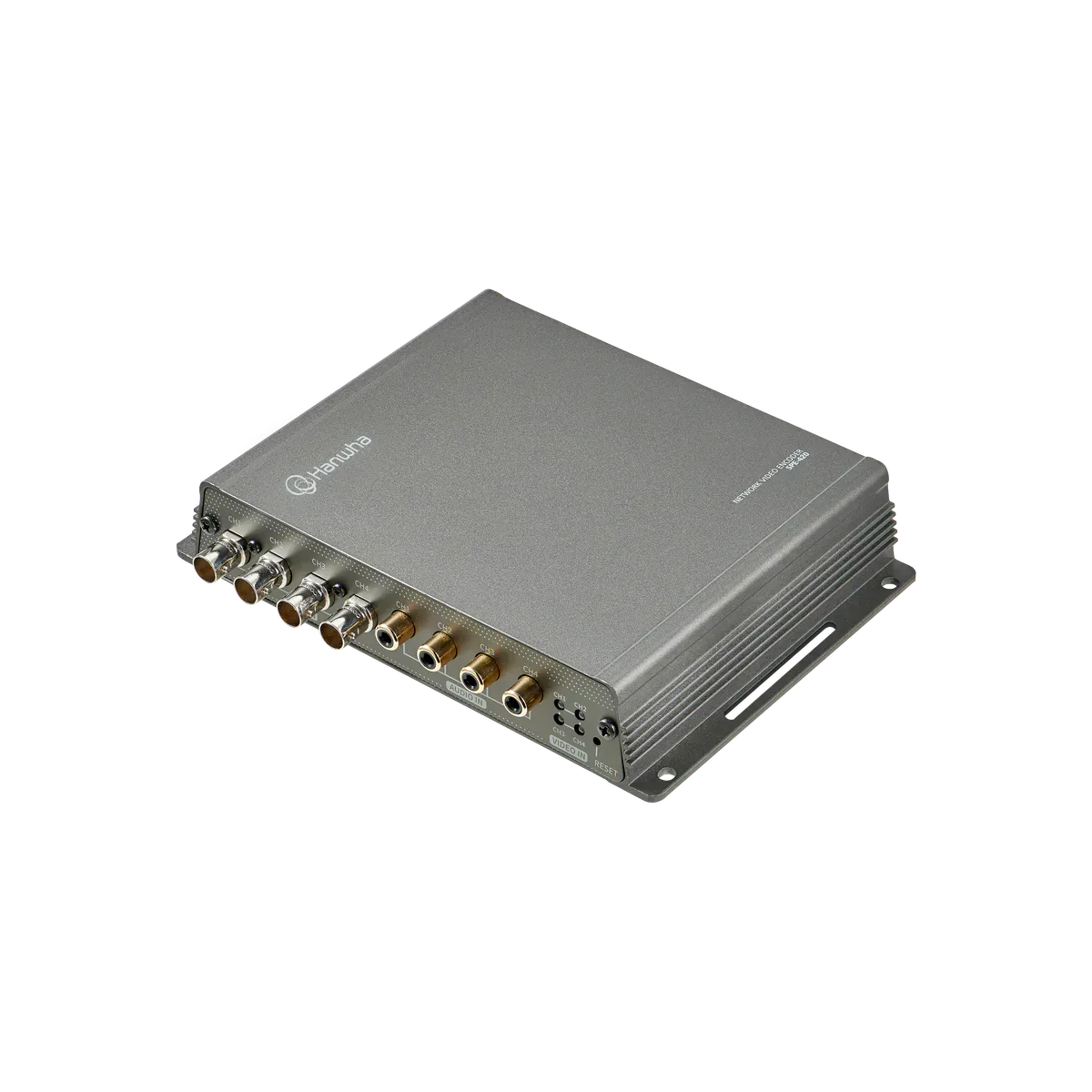
The Hanwha SPE-420 is a 4-channel hybrid video encoder that converts AHD, CVI, TVI, and CVBS analog cameras (up to 5MP) into H.265 / H.264 IP streams. Auto-detects analog format per channel, supports ONVIF Profile S, and powers from PoE — ideal for phased analog-to-IP migrations in Chicago commercial buildings and HOAs with existing coax wiring.
$535 MSRP · equipment only
Sold by order — most of these go in as part of an install, but we'll sell the hardware outright too. Availability, lead times, and project pricing: ask our manager when you request a quote.
We don't just ship boxes — this goes in as part of our security camera installation in Chicago work. From the Loop to Rogers Park — see our security work across Chicago.
Specifications
- SKU / Part Number
- SPE-420
- Brand
- Hanwha Vision
- Model
- SPE-420
- Series
- Wisenet
- Type
- 4-Channel Hybrid Video Encoder (analog → IP)
- Video Inputs
- 4 × BNC, 1.0 Vp-p / 75Ω composite (NTSC/PAL)
- Supported Analog Formats
- CVBS, AHD, CVI, TVI — auto-detected per channel
- Max Analog Input Resolution
- 5MP (also supports 4MP, 1080p, 720p, WD1, 4CIF, CIF)
- Video Output
- 1 × HDMI (4-multi image, 1920 × 1080)
- Video Compression
- H.265, H.264 (Main / Baseline / High), MJPEG
- Encoded Resolutions
- 2560×1920, 2560×1440, 1920×1080, 1280×720, 928×480/576, 704×480/576, 640×368, 352×240/288
- Max Frame Rate
- 5MP: 12 fps/CH · 4MP: 15 fps/CH · 1080p/720p/WD1/4CIF/CIF: 30 fps/CH (NTSC) / 25 fps/CH (PAL)
- Streaming
- Multi-streaming, up to 2 profiles per channel
- Audio Compression
- G.711 µ-law
- Audio I/O
- 4 line input / 1 line output
- Alarm I/O
- 4 input / 2 output (1 NO/COM/NC, 1 NO/COM)
- Event Triggers
- Motion detection, alarm input, video loss, tampering, network disconnect
- Network
- 1 × RJ-45 10/100 BASE-T
- Protocols
- ONVIF Profile S, SUNAPI (HTTP API)
- Power Input
- DC 12 V / PoE (IEEE 802.3af)
- Power Consumption
- Max 5 W (12 V, 0.417 A)
- Operating Temperature
- 0 °C to +50 °C (32 °F to 122 °F) — indoor
- Operating Humidity
- 20% to 80% RH
- Dimensions
- (W) 178.0 × (H) 34.0 × (D) 127.8 mm — desktop / shelf form factor
- Weight
- 520 g (1.15 lb)
- TAA / NDAA Compliance
- TAA-compliant variant: SPE-420/KUS
Best Fit & Recommended For
Hanwha SPE-420 — Bridge Your Existing Analog Cameras to a Modern IP NVR
The Hanwha SPE-420 from Hanwha Vision is a compact 4-channel hybrid video encoder that takes AHD, CVI, TVI, or CVBS analog camera signals (up to 5MP) over coax and re-encodes them as H.265, H.264, or MJPEG IP streams ready for any ONVIF-compatible NVR or VMS. The encoder auto-detects the analog format on each channel, runs on PoE or DC 12 V, and ships in a small desktop / shelf form factor (178 × 34 × 128 mm) that drops cleanly into an IT closet rack or wall-mounted enclosure.
For Chicago commercial buildings, condos, HOAs, and property-management portfolios with existing coax-cabled CCTV — which is most older buildings in this market — the SPE-420 is a key tool in the analog-to-IP migration playbook. It lets you keep working cameras and existing wiring in place while upgrading the recorder, adding remote viewing, and unifying the system under modern VMS management.
Why an Encoder Makes Sense for Chicago Buildings
Most Chicago commercial buildings built or last renovated before 2018 have analog CCTV: BNC connectors, RG-59 or RG-6 coax in walls and risers, and a DVR or hybrid recorder somewhere in the IT closet. The cameras themselves often still produce a usable image — they were properly specified the first time, and analog HD formats like AHD and TVI deliver decent resolution. The problem is usually elsewhere:
- The DVR is at end-of-life — failing hard drives, no firmware updates, no remote access, no integration with a modern VMS
- You want to bring multiple buildings under one VMS — but each property runs on a different recorder platform
- A new tenant or compliance requirement demands secure remote viewing, audit logs, or AI-aware analytics that the old recorder can’t deliver
- The owner is selling the property and a modern security platform improves perceived value during due diligence
In all of these scenarios, ripping out every camera and re-cabling the building is expensive, disruptive, and rarely budgeted. The SPE-420 lets us solve the recorder-side problem first: bridge the existing analog cameras to a modern IP NVR (Hanwha Wisenet, Avigilon, Axis Camera Station, or any ONVIF-based platform), then plan camera replacements over time as cameras fail or budgets allow.
What the SPE-420 Actually Does
Each of the four analog inputs on the SPE-420 accepts a standard BNC connector (1.0 Vp-p / 75 Ω composite). When you connect a camera, the encoder auto-detects the format — CVBS, AHD, CVI, or TVI — and configures the channel accordingly. From there, the encoder produces an H.265, H.264, or MJPEG IP stream that any ONVIF Profile S recorder picks up exactly as if it were a native IP camera.
Key practical points:
- Multi-streaming up to 2 profiles per channel — record one high-quality profile to the NVR while sending a lower-bitrate profile to a remote viewing client or wall display
- Up to 5MP analog input resolution — supports modern AHD/TVI/CVI HD cameras at 5MP (12 fps), 4MP (15 fps), or 1080p / 720p / standard-def at 30 fps (NTSC) or 25 fps (PAL)
- HDMI output — local 1920 × 1080 monitor output with a 4-channel multi-image view, useful for a rack-mounted local display
- G.711 µ-law audio with 4 line inputs and 1 line output — for cameras paired with separate microphones, or for systems with audio talk-down
- Alarm I/O — 4 inputs and 2 relay outputs, plus event triggers for motion, video loss, tampering, alarm contact, and network disconnect
Compression That Cuts Storage Costs
The SPE-420 supports modern H.265 (HEVC) compression in addition to H.264 and MJPEG. For a typical Chicago condo or office migration where the existing recorder might be writing H.264 baseline or even MJPEG-only, switching to H.265 alone often reduces storage requirements by 40–50% at the same image quality — which means longer retention on the same drives, or smaller drive arrays for the same retention window. We tune the bitrate, GOP structure, and stream profiles during commissioning to match the customer’s retention and quality targets.
Indoor Installation Only — Plan the Encoder Location
The SPE-420 is rated for indoor environments only — operating range 0 °C to +50 °C (32 °F to 122 °F) at 20–80% RH humidity. The cameras themselves can be outdoor-rated and survive Chicago winters, but the encoder must stay in a conditioned space — typically the IT closet, telecom room, or a rack in the building’s main equipment room. Coax runs from the cameras to the encoder location; Cat6 carries the encoded IP streams from the encoder to the NVR.
In practical terms: if your existing recorder is already in a conditioned IT closet, the SPE-420 drops in next to it. If your old DVR was somehow installed in a stairwell or unconditioned utility space (we have seen both), we plan a relocation as part of the migration project.
TAA / NDAA Compliance — the /KUS Variant
For federally funded projects in Chicago — HUD-funded affordable and senior housing, federally funded schools, GSA office space, federal transit-related developments — Hanwha publishes a TAA-compliant variant under the SKU SPE-420/KUS. The /KUS suffix denotes the supply chain that meets the Trade Agreements Act and NDAA Section 889 sourcing requirements. We specify the /KUS variant on the bid for any project where compliance is a contractual or grant requirement. Functionally and visually it is the same encoder.
A Realistic Migration Path
For most Chicago commercial buildings, an analog-to-IP migration using the SPE-420 follows this rough pattern:
- Audit the existing system — map every camera location, identify the analog format (CVBS / AHD / CVI / TVI / mixed), assess camera health, document coax runs, and confirm the recorder location is suitable for IP equipment.
- Replace the recorder first — install a modern IP NVR or VMS server, sized for current camera count plus 30–50% growth headroom.
- Bridge analog cameras with encoders — one SPE-420 per 4 analog cameras, mounted in the same rack or shelf as the new NVR. PoE-powered from a small managed PoE switch.
- Add native IP cameras for new locations — any new camera position (a new entry, a new perimeter zone, a new amenity space) goes in as native IP from day one.
- Replace analog cameras incrementally — as cameras fail, as budget allows, or as we identify locations where image quality is the bottleneck. Each replacement removes one channel from the encoder load.
- Retire the encoder when only one or two analog cameras remain, or keep it indefinitely if some legacy cameras remain useful and the owner does not want to re-cable.
This pattern lets the building run on a modern recording platform from day one of the project, while spreading camera replacement costs over years rather than absorbing them all at once.
Installation Considerations for Chicago Properties
When Vidimost installs the SPE-420 as part of a migration project, we plan around several factors that affect long-term reliability and serviceability:
Coax cable condition: RG-59 and RG-6 coax in older Chicago buildings often shows signs of decades of service — cracked dielectric, oxidized shields, water damage near roof penetrations. We test each run during the audit and re-terminate or splice damaged sections before connecting the encoder. Encoders are sensitive to signal-quality issues that older DVRs tolerated.
Network and PoE infrastructure: Each SPE-420 needs a PoE-capable port (IEEE 802.3af, ~5 W) on the network switch. We size the PoE budget on the switch to support all encoders plus headroom for future native IP cameras.
Rack mounting and cable management: The SPE-420 is a desktop / shelf form factor, not a rack-ear unit. We mount it on a 1U or 2U shelf in the network rack, with neat coax routing on the input side and a single Cat6 patch on the output side.
NVR and VMS configuration: We add the encoder to the NVR via ONVIF discovery or static IP, configure the stream profiles, set up motion zones per channel, and confirm event triggers (motion, video loss, tampering) are firing correctly. Each channel is named to match the corresponding camera location for clean playback and search.
Long-term plan documentation: We hand over a written migration plan: which cameras to replace first, expected camera lifespan estimates, encoder serviceability notes, and a timeline for phased upgrades. Property managers and owners use this for budgeting capital expenditures across multi-year horizons.
Professional Analog-to-IP Migration by Vidimost in Chicago
Vidimost LLC handles end-to-end analog-to-IP migration projects across the city of Chicago — downtown to the neighborhood corridors, and downtown Chicago. Our scope on a typical encoder-based migration includes:
- Existing-system audit — full inventory of analog cameras, coax runs, recorder hardware, and network infrastructure
- Equipment specification — encoder count, NVR / VMS sizing, PoE switch sizing, storage planning, /KUS variant selection if compliance applies
- Equipment installation — rack mounting, coax termination, Cat6 patching, PoE switch configuration, NVR commissioning
- ONVIF integration and stream tuning — encoder-to-NVR pairing, profile and bitrate tuning to match retention targets
- Event configuration — motion zones, tampering alerts, video loss notifications, network disconnect alarms
- Remote viewing setup — secure access on phones, tablets, and desktops for property managers and authorized staff
- Migration plan handoff — written multi-year roadmap for incremental camera replacement
- Ongoing support — firmware updates, troubleshooting, expansion as the camera fleet evolves
Whether you are running an aging analog DVR that needs to come off life-support, planning a phased camera modernization across a property portfolio, or specifying TAA-compliant equipment for a federally funded project — contact us for a free site walkthrough and quote.