
Hanwha SPD-152 Compact Video Decoder — Up to 64-Channel Display via Dual HDMI
Model / Series: SPD-152
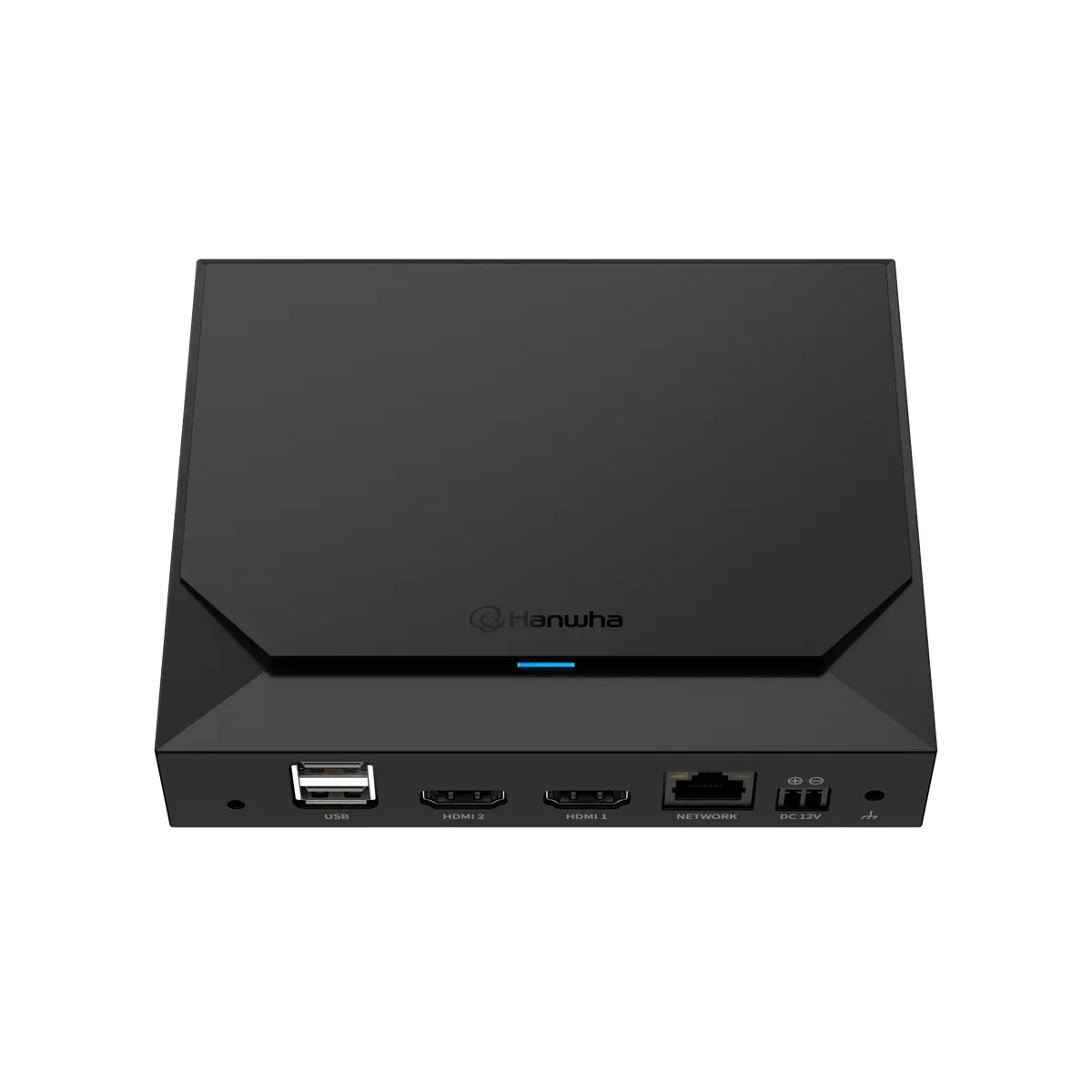
The Hanwha SPD-152 is a compact IP video decoder displaying up to 64 cameras (HDMI Clone mode) or 36+25 cameras (Expand mode) on dual HDMI outputs — 4K @ HDMI #1, 1080p @ HDMI #2. Supports H.265 / H.264 / MJPEG codecs, audio output, ONVIF, PoE-powered, VESA monitor-back mountable. The replacement for SPD-150. For Chicago security desks, lobby video walls, guard stations, and monitor-wall deployments — TAA-compliant variant SPD-152/KEX available.
$850 MSRP · equipment only
Sold by order — most of these go in as part of an install, but we'll sell the hardware outright too. Availability, lead times, and project pricing: ask our manager when you request a quote.
We don't just ship boxes — this goes in as part of our security camera installation in Chicago work. Inheriting a half-working setup from a previous vendor? Start with a security system takeover.
Specifications
- SKU / Part Number
- SPD-152
- Brand
- Hanwha Vision
- Model
- SPD-152
- Series
- Wisenet
- Type
- IP Video Decoder (compact, dual HDMI output)
- Decoded Channels (HDMI #1 Clone Mode)
- Up to 64 cameras
- Decoded Channels (Expand Mode)
- 36 (HDMI #1) + 25 (HDMI #2)
- Supported Codecs
- H.265 / H.264 / MJPEG
- Decoding Performance
- 8MP @ 60 fps · 2MP @ 360 fps
- HDMI #1 Output
- Up to 4K (3840 × 2160 @ 30 Hz) — with audio
- HDMI #2 Output
- Up to 1080p (1920 × 1080 @ 60 Hz) — no audio
- Supported Output Resolutions
- 3840 × 2160 @ 30 Hz, 2560 × 1440 @ 30 Hz, 1920 × 1080 @ 60 Hz
- Audio Output Codecs
- G.711 / G.726 / AAC
- Network Speed
- Up to 150 Mbps
- Network Protocols
- RTP, RTSP, HTTP, CGI (SUNAPI), ONVIF
- Power Input
- 12 V DC / PoE (IEEE 802.3af)
- Power Consumption
- Max 11.0 W (12 V DC) / Max 12.95 W (PoE)
- Operating Temperature
- 0 °C to +40 °C (32 °F to 104 °F) — indoor
- Dimensions
- 140 × 29.5 × 115.4 mm (5.51 × 1.16 × 4.54 in)
- Weight
- 260 g (0.57 lb)
- Mounting
- VESA monitor-back mount or pole mount included
- TAA / NDAA Compliance
- TAA-compliant variant: SPD-152/KEX
Best Fit & Recommended For
Hanwha SPD-152 — Compact IP Video Decoder, Dual HDMI Output
The Hanwha SPD-152 is a compact IP video decoder from Hanwha Vision’s Wisenet line — purpose-built for displaying live IP camera streams on standard HDMI monitors at security desks, lobby video walls, guard stations, and manager offices, without requiring a PC or VMS workstation. The SPD-152 takes camera streams from the network, decodes them in hardware, and outputs the multi-image grid to dual HDMI displays — HDMI #1 at up to 4K with audio, HDMI #2 at up to 1080p. Up to 64 cameras display simultaneously in HDMI #1 Clone mode, or 36 + 25 cameras split across the two outputs in Expand mode.
The SPD-152 is the replacement model for the older SPD-150 — adding H.265 codec support, dual HDMI outputs, larger camera-count capacity, more compact form factor, PoE power, and a TAA-compliant variant (SPD-152/KEX).
For Chicago apartment lobbies, hotel front desks, hospital security stations, school administrator offices, retail back-of-house, multi-tenant building concierge positions, and any commercial space where live camera coverage needs to be displayed on a dedicated monitor — the SPD-152 is one of the cleanest and most cost-effective options in Hanwha’s lineup.
What a Video Decoder Does (and Why You’d Want One)
A video decoder is a small networked appliance — not a recorder, not a VMS workstation. It takes IP camera streams from the network and outputs them to HDMI displays as a multi-image grid. The result: any HDMI monitor (TV, computer monitor, dedicated security display) becomes a live camera-display screen.
Why a decoder instead of a PC running VMS client software:
- No PC to manage — no Windows / Linux to patch, no antivirus, no VMS client crashes, no idle reboots, no graphics-card heat issues
- Dedicated, single-purpose device — boots in seconds, displays live cameras, and that’s it. Reliability is significantly higher than a PC at the same task
- Compact and silent — 140 × 29.5 × 115.4 mm, fanless, mounts behind the monitor on the included VESA bracket. No PC tower at the security desk
- PoE-powered — single Cat6 cable carries power and network. No AC outlet needed at the monitor location
- Tamper-resistant — no keyboard or mouse means operators can’t accidentally close the camera view, exit to desktop, or browse the internet on the security display
- Lower TCO — one-time hardware purchase, minimal ongoing maintenance, no software-license renewal
For Chicago apartment lobbies, hospital security desks, school administrator offices, retail back-of-house, and any “display only — no operator interaction needed” position, the decoder is significantly more practical than a PC + VMS workstation.
Up to 64 Cameras on Dual HDMI
The SPD-152’s display capacity scales with the resolution of each output:
| Mode | HDMI #1 | HDMI #2 |
|---|---|---|
| Clone mode (same view both outputs) | Up to 64 cameras at 1080p layouts | Mirrors HDMI #1 |
| Expand mode (different views per output) | Up to 36 cameras at 4K | Up to 25 cameras at 1080p |
Layout patterns are configurable per output: 1, 4, 9, 16, 25, 36, 64-camera grids. The decoder also supports sequence / tour patterns that rotate camera views automatically over time — useful when there are more cameras than fit on one screen and the operator needs cyclical visibility.
The decoding performance budget is 8MP @ 60 fps total OR 2MP @ 360 fps total — meaning at 4K resolution the realistic concurrent-stream count is lower than at 1080p. We size the per-output camera count and resolution during commissioning based on the customer’s NVR camera mix.
SPD-152 vs. SPD-150 — Why the New Model Matters
The SPD-150 is Hanwha’s older decoder, listed by Hanwha as having a replacement model — the SPD-152 (this page). Why specify the new SPD-152:
| Feature | SPD-150 | SPD-152 (this) |
|---|---|---|
| Max camera display | Up to 48 (HDMI / VGA) | Up to 64 (HDMI Clone) |
| Codecs | H.264, MJPEG | H.265, H.264, MJPEG |
| HDMI outputs | 1 (HDMI + VGA legacy) | 2 (dual 4K / 1080p) |
| Power | DC (typical) | PoE (single Cat6 cable) |
| Form factor | Standard | Compact (140×29.5×115.4 mm) |
| VESA mount | Per accessory | Included |
| TAA SKU | per Hanwha | SPD-152/KEX explicit |
For new installations, the SPD-152 is the right specification. The SPD-150 remains relevant only for spare-part service on existing installations.
Installation Patterns We Use in Chicago
Apartment / condo lobby concierge desk — VESA-mounted SPD-152 behind a 32-inch HDMI monitor, displaying 16 lobby + entry + corridor cameras in a 4×4 grid. PoE from the building’s existing network closet, single Cat6 cable to the desk.
Hotel front desk — Dual-HDMI deployment: HDMI #1 at 4K showing 16 priority cameras (entries, lobby, parking) at high quality; HDMI #2 at 1080p showing 25 secondary cameras in a sequence rotation (back-of-house, hallways, amenity spaces).
Hospital security station — Multiple SPD-152 units feeding a 4-monitor wall, each decoder driving 2 monitors. Operator sees 64+ cameras simultaneously across the wall.
School administrator office — Single SPD-152 + 50-inch HDMI monitor displaying 25 cameras (entrances, hallways, parking) in a 5×5 grid during school hours.
Retail back-of-house — Compact SPD-152 mounted behind a 24-inch monitor at the manager’s desk, displaying 9 store cameras (entries, registers, stockroom).
Indoor Only — Plan the Decoder Position
The SPD-152 is rated 0 °C to +40 °C indoor — fits typical conditioned commercial indoor positions (security desks, lobbies, offices, monitoring rooms). The decoder must be installed in a conditioned space; cameras themselves can be outdoor (the network signal travels over Cat6 to the decoder location).
TAA / NDAA — the /KEX Variant
For federally funded Chicago projects, Hanwha publishes the TAA-compliant variant SPD-152/KEX. We specify the /KEX variant on the bid for any project requiring TAA / NDAA Section 889 compliance.
Professional Installation by Vidimost in Chicago
Vidimost LLC installs Hanwha SPD-152 video decoders across the city of Chicago — apartment / condo lobbies, hotel front desks, hospital security stations, school administrator offices, retail managers, and any position where live camera coverage needs to be displayed on dedicated monitors.
Our scope includes site walkthrough (monitor positions, viewing distances, operator role analysis), monitor specification (HDMI displays sized for the viewing distance), VESA mount or pole installation, Cat6 + PoE switch sizing, NVR / camera integration with stream tuning, multi-view layout configuration per output, sequence / tour setup if used, and operator training. Contact us for a free site walkthrough and quote.
Frequently Installed Together
Hanwha Vision
Hanwha SPE-420
The Hanwha SPE-420 is a 4-channel hybrid video encoder that converts AHD, CVI, TVI, and CVBS analog cameras (up to 5MP) into H.265 / H.264 IP streams. Auto-detects analog format per channel, supports ONVIF Profile S, and powers from PoE — ideal for phased analog-to-IP migrations in Chicago commercial buildings and HOAs with existing coax wiring.
View →Hanwha Vision
Hanwha SPE-1630
The Hanwha SPE-1630 is a 16-channel rackmount hybrid video encoder that converts AHD, CVI, TVI, and CVBS analog cameras (up to 5MP) into H.265 / H.264 IP streams. Auto-detects analog format per channel, gigabit network, ONVIF Profile S, HDMI 16-multi output, 4 audio inputs, 16 alarm inputs — ideal for whole-building or multi-floor analog-to-IP migrations in Chicago commercial buildings, condos, schools, and retail centers. TAA-compliant variant: SPE-1630/KUS.
View →