
HID Signo 20 Reader — Compact Multi-Technology Access Reader for Chicago Buildings
Model / Series: Signo 20
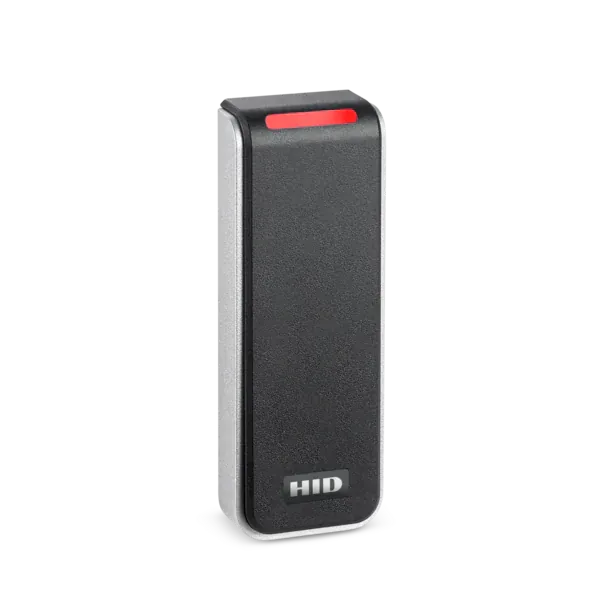
The HID Signo 20 is a mullion-format multi-technology access control reader supporting HID Mobile Access, iCLASS SE, SEOS, and legacy 125 kHz Prox credentials over OSDP v2 encrypted communication. Designed for narrow door frames, elevator panels, and glass mullions in commercial and residential buildings across Chicago.
$395 MSRP · equipment only
Sold by order — most of these go in as part of an install, but we'll sell the hardware outright too. Availability, lead times, and project pricing: ask our manager when you request a quote.
We don't just ship boxes — this goes in as part of our access control installation in Chicago work. First time working with us? Here’s why Chicago buildings pick Vidimost.
Specifications
- SKU / Part Number
- HID-20NKS-00-000000
- Credential Profile Pricing (MSRP)
- Seos profile $304 · Smart profile $354 · Standard profile $395
- Brand
- HID Global
- Model
- Signo 20
- Series
- HID Signo
- Part Number
- 20NKS-T0-000000
- Form Factor
- Mullion (compact)
- Dimensions
- 124.5 × 42.0 × 18.5 mm (4.9 × 1.65 × 0.73 in)
- Credential Technology
- HID Mobile Access, iCLASS SE, SEOS, Prox (125 kHz)
- Communication Protocol
- OSDP v2 (AES-128 encrypted) / Wiegand
- Operating Voltage
- 5–16 V DC
- Current Draw
- Typical 120 mA
- Read Range (Card)
- Up to 3.8 cm (1.5 in)
- Read Range (Mobile)
- Up to 5 cm (2.0 in) via BLE
- Operating Temperature
- −40 °C to +70 °C (−40 °F to +158 °F)
- Environmental Protection
- IP55
- Impact Resistance
- IK04
- Mounting
- Single-gang US box, surface-mount, or mullion
- Keypad
- No
- LED Indicators
- Multi-color programmable LED
- Audio
- Integrated piezo buzzer
- Certifications
- UL 294, FCC, IC, CE
Best Fit & Recommended For
HID Signo 20 — The Modern Standard for Compact Access Readers
The HID Signo 20 is HID Global’s current-generation mullion-format access control reader. It replaces the older iCLASS SE R10 and multiCLASS SE RP10 with a significantly more capable platform: native OSDP v2 encrypted communication, built-in Bluetooth Low Energy for mobile credentials, and simultaneous support for every major HID credential technology in a single compact housing.
For Chicago condos, offices, and commercial buildings managed by Vidimost, the Signo 20 is our standard recommendation when the door frame or mounting location requires a compact reader — and when the building is ready for secure, encrypted reader communication.
Why We Recommend the Signo 20 for Chicago Buildings
Chicago’s commercial and residential buildings present specific challenges that the Signo 20 handles well:
- Narrow aluminum door frames — Many Chicago high-rise lobbies and glass-door entries have mullion widths that cannot accommodate a full-size reader. The Signo 20 is only 42 mm wide
- Mixed credential populations — Buildings transitioning from legacy 125 kHz Prox cards to mobile access need a reader that handles both technologies simultaneously, without swapping hardware
- Elevator floor restriction — In condo and office towers, the Signo 20 mounts cleanly in elevator cab panels for floor-by-floor credential control
- Extreme temperature swings — With an operating range of −40 °F to +158 °F, the Signo 20 handles unheated Chicago parking garage vestibules, loading docks, and exterior stairwell entries
- Security-conscious properties — OSDP v2 encryption prevents the credential interception attacks that are possible on older Wiegand-based reader wiring
Multi-Technology Credential Support
One of the Signo 20’s strongest advantages is true multi-technology reading. A single Signo 20 reader simultaneously supports:
| Credential Type | Technology | Use Case |
|---|---|---|
| HID Mobile Access | BLE / NFC | Residents and staff unlock doors with a smartphone — no card to lose or replace |
| HID SEOS | 13.56 MHz smart card | High-security smart credentials with mutual authentication and encrypted data |
| HID iCLASS SE | 13.56 MHz | Current-generation contact-less smart cards used across commercial buildings |
| HID iCLASS | 13.56 MHz | Legacy smart cards still common in older installations |
| HID Prox | 125 kHz | Legacy proximity cards — supported for backward compatibility during migrations |
This means a condo building in Lincoln Park can issue mobile credentials to younger residents who prefer smartphone access, standard cards to residents who want a physical fob, and still honor legacy Prox cards from the previous system — all on the same reader, at the same door, with no adapter modules or compromises.
OSDP v2 Encrypted Communication
The Signo 20 natively supports OSDP v2 (Open Supervised Device Protocol version 2), which is the industry replacement for the decades-old Wiegand interface. The practical differences matter:
Wiegand (legacy):
- Credential data transmitted in plaintext over dedicated wires
- Vulnerable to eavesdropping, interception, and replay attacks at the reader wire
- No tamper supervision — if someone cuts or taps the wire, the controller has no way to know
- One-way communication only (reader → controller)
OSDP v2 (Signo 20):
- AES-128 encrypted communication over RS-485 two-wire bus
- Credential data is encrypted end-to-end between reader and controller
- Supervised channel — the controller detects reader tamper, communication loss, and wiring faults
- Bi-directional communication enables remote reader firmware updates, LED/buzzer control, and diagnostic queries from the head-end
For buildings in Chicago where physical security of the reader wiring matters — especially in shared utility corridors, exposed conduit runs, and parking structures — OSDP v2 is a meaningful upgrade over Wiegand.
Installation Considerations for Chicago Properties
When Vidimost installs HID Signo 20 readers at Chicago-area properties, we pay attention to several factors that directly affect long-term reliability:
Wiring and cable planning: OSDP runs over RS-485, which uses a shielded twisted-pair cable. We plan cable runs to stay within RS-485 distance limits (up to 1,200 meters / 4,000 feet) and avoid electrical interference from elevator motors, HVAC equipment, and fluorescent ballasts common in Chicago commercial buildings.
Controller compatibility: We verify the access controller supports OSDP v2 before specifying Signo readers. Brivo ACS300 and ACS6000 controllers support OSDP natively. Paxton Net2 controllers work with Signo readers over Wiegand. We configure the correct protocol for each project.
Weather and mounting environment: For semi-exposed locations — parking garage pedestrian doors, loading dock entries, building exterior stairwells — we confirm the IP55 rating is adequate for the specific exposure and recommend the Signo 40 (IP65) if the reader faces direct rain or snow.
Credential enrollment workflow: We set up the credential enrollment process with the property manager or HOA board so they can add, remove, and manage resident/tenant credentials independently after installation. This includes mobile credential provisioning workflows for buildings using HID Mobile Access.
Backward compatibility plan: For buildings replacing older HID readers (R10, RP10, ProxPoint), we document which credentials are in circulation and confirm that the Signo 20 firmware is configured to read all required formats before the old readers are removed.
Signo 20 vs. Signo 40 — Which One for Your Door?
| Feature | Signo 20 | Signo 40 |
|---|---|---|
| Form Factor | Mullion (compact) | Standard (full-size) |
| Width | 42 mm | 85 mm |
| Best For | Narrow frames, elevator panels, glass doors | Standard door frames, wall-mounted |
| Protection | IP55 / IK04 | IP65 / IK08 |
| Weather Resistance | Indoor and covered outdoor | Full outdoor including direct rain/snow |
| Credential Technology | Same (Mobile, SEOS, SE, Prox) | Same |
| OSDP v2 | Yes | Yes |
| Keypad Option | Signo 20K | Signo 40K |
General rule: If the reader mounts on a narrow frame, in an elevator, or on a glass mullion — choose the Signo 20. If it mounts on a standard wall next to a door and may face weather — choose the Signo 40. Both readers share the same credential support and security features.
Professional Installation by Vidimost in Chicago
Vidimost LLC installs HID Signo 20 readers across the city of Chicago. We handle:
- Site walkthrough and reader placement planning — determining which doors need readers, which form factor fits, and how the wiring routes
- Reader mounting and wiring — clean, professional installation with proper cable management and conduit where required
- Controller configuration — OSDP v2 or Wiegand setup, depending on the controller platform
- Credential enrollment — programming initial cards, fobs, or mobile credentials and testing each one at the door
- Property manager training — showing your team how to add and remove credentials, pull access logs, and handle common administrative tasks
- Ongoing support — firmware updates, troubleshooting, and system expansion as your building’s needs change
Whether you are upgrading from an aging Prox-based system, expanding access control to new doors, or building a new credential infrastructure from scratch — contact us for a free estimate and site walkthrough.