
Hanwha QND-8011 5MP Ultra-Compact Indoor Dome — Lit-Indoor Coverage Without IR
Model / Series: QND-8011
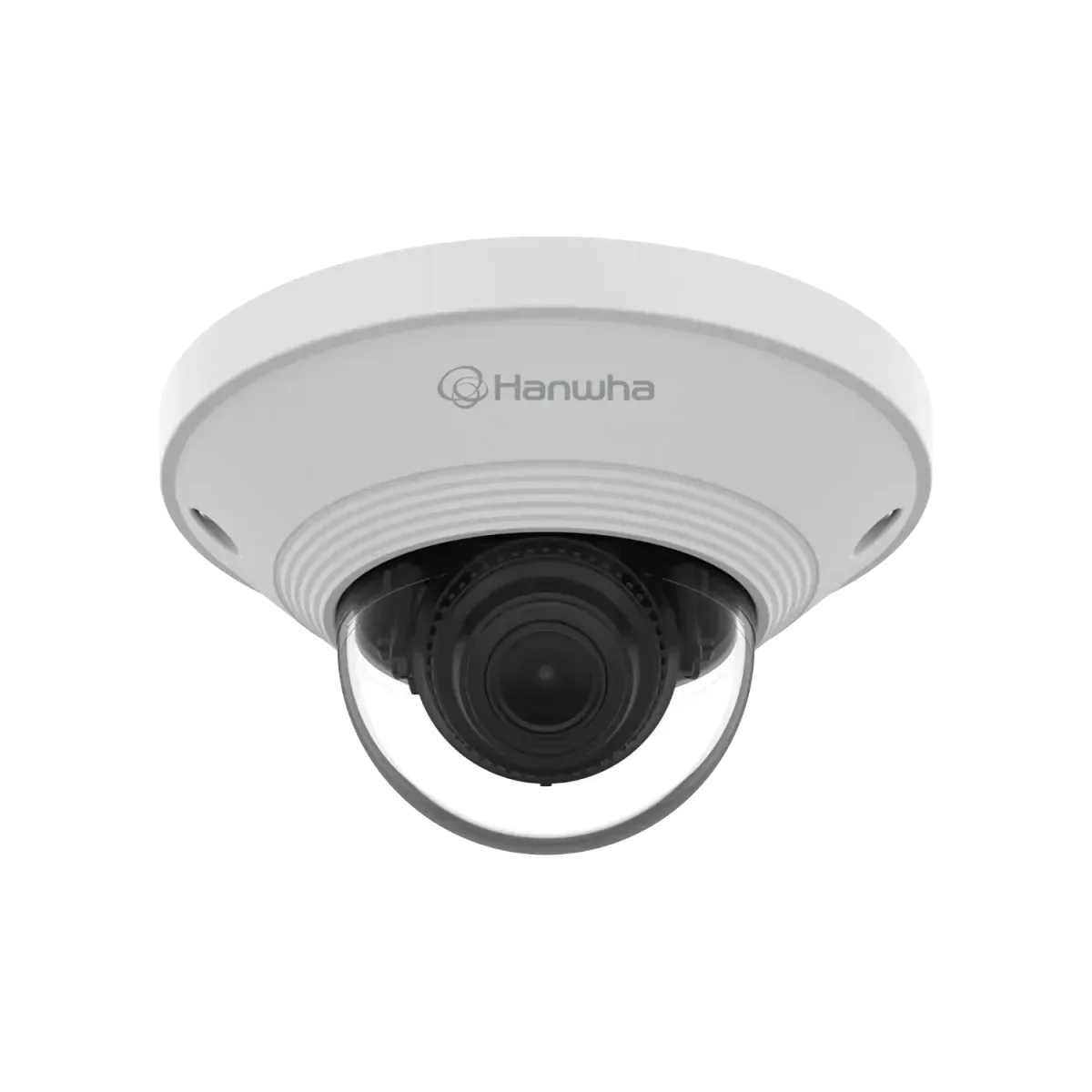
The Hanwha QND-8011 is a 5MP ultra-compact IP indoor dome camera with a 1/2.8" CMOS sensor, 2.8 mm fixed F2.0 lens (104° HFOV), 120 dB WDR, hallway view, people counting, and 165 g compact form factor — the no-IR variant of the QND-8010R for lit-indoor positions like office lobbies, retail interiors, hotel hallways, and apartment common areas where ambient lighting is consistent and IR would create reflection artifacts.
$400 MSRP · equipment only
Sold by order — most of these go in as part of an install, but we'll sell the hardware outright too. Availability, lead times, and project pricing: ask our manager when you request a quote.
We don't just ship boxes — this goes in as part of our security camera installation in Chicago work. City building? See our Chicago, IL service area.
Specifications
- SKU / Part Number
- QND-8011
- Brand
- Hanwha Vision
- Model
- QND-8011
- Series
- Wisenet Q
- Camera Type
- IP indoor compact dome (no IR — lit indoor positions)
- Image Sensor
- 1/2.8" 5MP CMOS
- Resolution
- 5MP (2592 × 1944)
- Max Frame Rate
- 30 fps / 25 fps (60 Hz / 50 Hz) at H.265 / H.264 — all resolutions
- Lens
- 2.8 mm fixed focal — wide angle
- Aperture
- F2.0
- Field of View
- Horizontal 104.4° / Vertical 76.7° / Diagonal 136.1°
- Day/Night
- Auto (electronic — ICR)
- IR Illumination
- Not included — designed for lit indoor positions
- Minimum Illumination (Color)
- 0.15 lux (F2.0, 1/30 s)
- WDR
- 120 dB
- Video Compression
- H.265 / H.264 / MJPEG — Multiple streaming
- Video Analytics
- Defocus detection, Motion detection, Tampering
- Business Intelligence
- People Counting (retail business intelligence)
- Hallway View
- Supported
- Audio
- Not supported
- Alarm I/O
- Not listed
- Network
- RJ-45 (10/100 BASE-T)
- ONVIF
- Profile S, Profile G, Profile T
- Edge Storage
- microSD up to 128 GB (1 slot)
- Power Input
- PoE (IEEE 802.3af, Class 2 — lower power class)
- Power Consumption
- Max 5.00 W, typical 4.00 W
- Operating Temperature
- −10 °C to +40 °C (+14 °F to +104 °F)
- Environmental Protection
- IP42 (indoor — dust-protected, drip-resistant)
- Impact Resistance
- IK08 (moderate impact)
- Dimensions
- Ø 99.0 × 56.0 mm (Ø 3.90 × 2.20 in)
- Weight
- 165 g (0.36 lb) — exceptionally lightweight
- TAA / NDAA Compliance
- NDAA-compliant per Hanwha Vision documentation
Best Fit & Recommended For
Hanwha QND-8011 — 5MP Ultra-Compact Indoor Dome for Lit-Indoor Positions
The Hanwha QND-8011 is a 5MP IP indoor dome camera from Hanwha Vision’s Wisenet Q series — the no-IR variant of the QND-8010R, purpose-built for lit indoor positions where ambient lighting is consistent and IR illumination would actually degrade image quality through reflection artifacts. The QND-8011 combines a 1/2.8” 5MP CMOS sensor with a wide 2.8 mm F2.0 lens (104° HFOV), 120 dB WDR, hallway view, People Counting business intelligence, and an ultra-compact 165 g housing (Ø 99 × 56 mm) — roughly half the weight of the QND-8010R IR variant.
For Chicago office lobbies, hotel hallways, retail interiors, healthcare reception, and apartment building common areas with consistent ambient lighting, the QND-8011 is one of our cost-controlled compact indoor dome picks.
Why a No-IR Indoor Dome?
Most modern commercial buildings maintain consistent ambient lighting — emergency lighting on hallway circuits, nightlight illumination at front desks, 24/7 lobby lighting for security and code compliance. At these positions, adding IR illumination is counterproductive:
- IR reflects off glass surfaces — lobby glass doors, retail display windows, framed artwork, mirrors create bright IR hot-spots that wash out the image
- IR reflects off shiny floor surfaces — polished concrete, marble, lacquered hardwood — creating glare patterns
- IR creates uneven exposure — when ambient light is sufficient for the camera, IR LEDs can cause the camera to under-expose ambient-lit areas while over-exposing IR-illuminated nearby surfaces
- Visible IR glow — even though “invisible,” IR LEDs produce a faint visible glow that some users find aesthetically intrusive in premium hospitality / retail spaces
The QND-8011 simply doesn’t include IR — relying entirely on the F2.0 lens and 5MP sensor to capture clean images at typical commercial indoor light levels. For lit-indoor positions, this often produces better image quality than an IR-equipped equivalent.
When to Choose QND-8011 vs. QND-8010R
| Spec | QND-8011 (this — no IR) | QND-8010R (with IR) |
|---|---|---|
| Resolution | 5MP | 5MP |
| Lens | 2.8 mm F2.0 | 2.8 mm F2.0 |
| HFOV | 104.4° | 104.7° |
| IR distance | None — lit-indoor only | 20 m |
| Audio | — | — |
| PoE class | Class 2 (5 W max) | Class 3 (7.5 W max) |
| IP / IK | IP42 / IK08 | Indoor only |
| Weight | 165 g | 360 g |
| Form factor | Ultra-compact | Standard compact |
| Best fit | Lit-indoor positions | Mixed-light positions or zero-ambient-light scenes |
Decision rule: if the position has consistent ambient light during all monitored hours (lobbies with emergency lighting, hotel hallways with nightlight, retail with business-hour lighting), the QND-8011 is the right pick — better image quality, smaller form factor, lower power, lower cost. If the position goes fully dark for any monitored period (back-of-house storage, basement corridors, after-hours non-emergency-lit spaces), the QND-8010R’s IR is required.
Wisenet Q Edge Analytics + People Counting
Standard indoor analytics (defocus / motion / tampering) plus People Counting — count people crossing defined lines / entering zones for retail traffic measurement, restaurant capacity, healthcare occupancy compliance.
For deeper AI features (Person / Vehicle classification, attribute search, cloud-direct), step up to the QND-C8013R C-series Q (AI + cloud) or PND-A9081RF P-series premium AI dome.
Where the QND-8011 Sits in the Hanwha Indoor Dome Lineup
| Need | Recommended Camera |
|---|---|
| 5MP lit-indoor / no IR / cost-controlled | QND-8011 (this) |
| 5MP indoor with IR | QND-8010R |
| 5MP indoor flateye with IR + IP67/IK10 | QNE-8011R |
| 5MP indoor AI + cloud-ready | QND-C8013R |
| 4MP entry flateye with F1.2 fast lens (no IR) | ANE-L7012L |
| 4K premium AI cloud-direct | PND-A9081RF |
Ultra-Lightweight 165 g — Drop-Ceiling Friendly
At 165 g, the QND-8011 is one of the lightest commercial-grade indoor domes — installs cleanly on T-bar drop ceilings without additional support brackets. For Chicago commercial properties with extensive drop-ceiling installations (offices, retail, healthcare, hospitality), this simplifies mounting and reduces installation labor.
Lower PoE Class 2 Power — High-Density Camera Deployments
The QND-8011 draws max 5 W at PoE Class 2 — significantly less than typical Class 3 cameras. For high-density indoor camera deployments (large retail floors, hotel hallway runs, apartment common-area fleets), this lets a single PoE switch handle roughly 3× more cameras than Class 3 equivalents on the same total PoE budget.
Cloud-Ready Status
The QND-8011 is a standard ONVIF Profile S / G / T camera designed for traditional NVR / VMS architecture. It does not natively connect to Hanwha’s CloudConnector cloud-direct platforms. For cloud-direct indoor deployments, the QND-C8013R C-series (AI + cloud) and PND-A9081RF (premium AI cloud) are the right picks.
Professional Installation by Vidimost in Chicago
Vidimost LLC installs Hanwha Wisenet Q indoor domes across the city of Chicago. The QND-8011 is one of our standard cost-controlled indoor dome picks for lit-indoor positions at offices, hotels, retail, healthcare, and apartment common areas.
Our scope includes site walkthrough (assessing whether the position’s ambient lighting is consistent enough for no-IR coverage), drop-ceiling or hard-ceiling mounting, cable runs, PoE switch and NVR sizing (Class 2 capable), NVR configuration, motion-zone tuning, people-counting setup, hallway-view configuration where applicable, remote viewing, and property manager training. Contact us for a free site walkthrough and quote.
Frequently Installed Together
Hanwha Vision
Hanwha QND-8010R
The Hanwha QND-8010R is a 5MP IP indoor IR dome camera with a 1/2.8" CMOS sensor, wide 2.8 mm fixed F2.0 lens (104° HFOV), 20 m IR, 120 dB WDR, hallway view, alarm I/O, and PoE. Compact indoor dome (Ø 110 × 90 mm, 360 g) for Chicago office lobbies, retail interiors, hotel hallways, and apartment common areas where high-resolution wide coverage is needed without the cost of premium AI. TAA-compliant variant: QND-8010R/KAP.
View →Hanwha Vision
Hanwha QNE-8011R
The Hanwha QNE-8011R is a 5MP IP super-compact flateye camera with built-in IR, 1/2.8" CMOS sensor, 2.8 mm fixed F2.0 lens (104° HFOV), 20 m IR, 120 dB WDR, IP67 / IK10 housing, hallway view, and PoE — Wisenet Q tier with vandal-rated and water-resistant housing for premium indoor and semi-outdoor positions across Chicago commercial buildings.
View →