
Hanwha QNV-8080R 5MP Vandal Dome Camera — IR Outdoor Surveillance for Chicago Properties
Model / Series: QNV-8080R
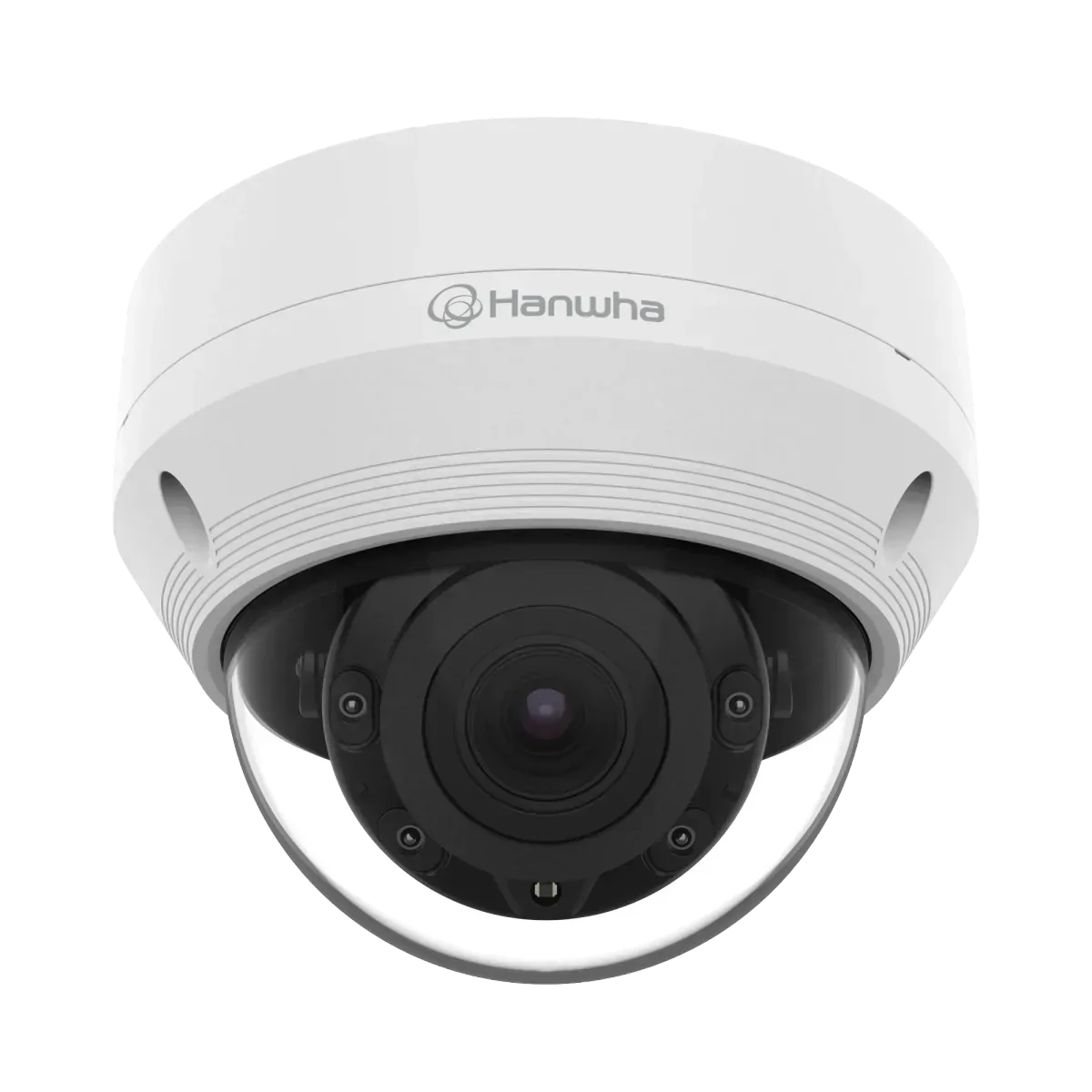
The Hanwha QNV-8080R is a 5MP IR vandal-resistant outdoor dome camera with a 3.2–10 mm motorized varifocal lens, 120 dB WDR, IP66 / IK10 housing, and a TAA-compliant variant (QNV-8080R/KME) for NDAA Section 889 projects. Built for Chicago commercial buildings, parking structures, condos, and retail exteriors.
$690 MSRP · equipment only
Sold by order — most of these go in as part of an install, but we'll sell the hardware outright too. Availability, lead times, and project pricing: ask our manager when you request a quote.
We don't just ship boxes — this goes in as part of our security camera installation in Chicago work. Inheriting a half-working setup from a previous vendor? Start with a security system takeover.
Specifications
- SKU / Part Number
- QNV-8080R
- Brand
- Hanwha Vision
- Model
- QNV-8080R
- Series
- Wisenet Q
- Image Sensor
- 1/2.8" 5MP CMOS
- Resolution
- 5MP (2592 × 1944) at 30 fps (60 Hz) / 25 fps (50 Hz)
- Lens
- 3.2–10 mm motorized varifocal (3.1× optical zoom)
- Aperture
- F1.6 (wide) – F2.9 (tele)
- Field of View (Horizontal)
- 100.3° (wide) – 31.2° (tele)
- Field of View (Vertical)
- 72.3° (wide) – 23.5° (tele)
- Field of View (Diagonal)
- 133.1° (wide) – 38.8° (tele)
- Day/Night
- Auto (mechanical IR cut filter / ICR)
- Minimum Illumination (Color)
- 0.15 lux (F1.6, 1/30 s)
- Minimum Illumination (B/W)
- 0 lux (IR LED on)
- Electronic Shutter
- 1/5 – 1/12,000 s
- WDR
- True WDR 120 dB
- IR Illumination
- Built-in IR LED — viewable distance up to 30 m (98 ft)
- Video Compression
- H.265 (Main / High) / H.264 (Main / High) / MJPEG with WiseStream II
- Streaming
- Up to 3 profiles, 6 unicast users / multicast
- Video Analytics
- Defocus detection, Directional detection, Motion detection, Enter/Exit, Tampering, Virtual line
- Audio
- Not supported
- Alarm I/O
- 1 input / 1 output
- Edge Storage
- microSD / SDHC / SDXC up to 128 GB (1 slot)
- Network
- RJ-45 10/100 BASE-T
- ONVIF
- Profile S, Profile G, Profile T
- Power Input
- PoE (IEEE 802.3af, Class 3)
- Power Consumption
- PoE: max 8.90 W, typical 6.60 W
- Operating Temperature
- −30 °C to +55 °C (−22 °F to +131 °F)
- Environmental Protection
- IP66 (weatherproof)
- Impact Resistance
- IK10 (vandal-resistant)
- TAA / NDAA Compliance
- TAA-compliant variant: QNV-8080R/KME
- Mounting
- Hanging mount: SBP-301HMW2 · Back box: SBV-136BW · Compatible with corner, wall, pole, and pendant accessories
- Dimensions
- Ø 137.0 × 106.1 mm (Ø 5.39 × 4.18 in)
- Weight
- 700 g (1.54 lb)
Best Fit & Recommended For
Hanwha QNV-8080R — 5MP Vandal Dome Camera Built for Chicago Outdoor Surveillance
The Hanwha QNV-8080R is a 5MP IR vandal-resistant outdoor dome camera from Hanwha Vision’s Wisenet Q series — the value tier in Hanwha’s professional line, sharing the same firmware platform, ONVIF compatibility, and ecosystem support as the higher-tier P and X series. The QNV-8080R is purpose-built for outdoor commercial surveillance: a 3.2–10 mm (3.1×) motorized varifocal lens, 120 dB true WDR, built-in IR with 30-meter viewable distance, and an IP66 / IK10 housing rated for both Chicago weather and physical tampering. A TAA-compliant variant (QNV-8080R/KME) is available for federally funded projects that require NDAA Section 889 sourcing.
For Chicago condos, office buildings, parking structures, retail centers, and HOA properties, the QNV-8080R is one of Vidimost’s go-to recommendations when the project requires reliable outdoor coverage at a sensible price point.
Why We Recommend the QNV-8080R for Chicago Properties
Chicago’s commercial environment puts specific demands on outdoor cameras that the QNV-8080R handles cleanly:
- Cold winters and freeze-thaw cycles — Operating range of −30 °C to +55 °C (−22 °F to +131 °F) covers nearly every Chicago weather pattern from January cold snaps to August humidity. IP66 sealing keeps blowing snow and lake-effect rain out of the housing
- Vandalism and physical exposure — IK10 rating means the housing absorbs impact from rocks, baseball bats, and accidental parking-deck vehicle strikes without compromising the camera. This matters for ground-floor retail, parking ramps, and tenant-accessible building perimeters
- Wide outdoor scenes — A 3.1× motorized varifocal lens (3.2–10 mm, 100.3°–31.2° horizontal field of view) lets us cover a wide aisle or zoom into a specific entry, then re-adjust remotely without sending a tech back to the camera
- Backlit lobby and storefront entries — 120 dB true WDR balances the bright sky behind a doorway against the darker interior — a common challenge at glass-fronted Chicago commercial buildings and retail entries
5MP Resolution and 1/2.8” CMOS Sensor
A 5MP (2592 × 1944) sensor sits between the older 2MP / 1080p generation and current 4K models. In practical terms: roughly 2.5× the pixel count of 1080p, which translates to more usable detail when zooming into recorded footage to identify faces, read license plates at the right distance, or pick out clothing and vehicle details. For wider scenes — parking aisles, building perimeters, retail floors — the higher resolution often lets us reduce the total number of cameras needed for the same coverage area.
The 1/2.8” CMOS sensor and 120 dB true WDR also help with image quality in mixed-light conditions: dawn and dusk, glass-fronted lobbies with bright exterior light, shaded parking-deck entries against open sky.
Outdoor-Hardened Housing: IP66 and IK10
Outdoor cameras live or die on the housing. The QNV-8080R uses a sealed dome design with two ratings that matter:
| Rating | What it Means | Real-World Use |
|---|---|---|
| IP66 | Dust-tight (IP6_) and protected against powerful water jets (IP_6) | Direct rain, snow, sleet, lake-effect storms, pressure-washing during cleaning cycles |
| IK10 | Highest impact rating in the IK scale — withstands a 5 kg mass dropped from 400 mm | Resists baseball bats, rocks, accidental ladder strikes, parking-deck vehicle bumper contact |
For exterior installations on parking decks, building perimeters, loading docks, and retail storefronts in Chicago — where weather and vandalism are both real risks — these ratings make the difference between a camera that runs reliably for years and one that needs replacement after a single bad winter.
Built-In IR for Zero-Light Scenes
The QNV-8080R has integrated IR illumination with a viewable distance up to 30 meters (98 feet). The IR LEDs sit inside the dome behind a lens designed to minimize IR reflection and bloom on the dome glass — a common problem on cheaper cameras where IR bounces off the cover and washes out the image.
In practice, the QNV-8080R produces clean black-and-white footage in complete darkness — unlit parking decks at 3 AM, building perimeters with no exterior lighting, rear loading docks after hours. The auto IR cut filter (ICR) switches between color (daytime) and B&W IR (nighttime) modes based on ambient light, so the camera adapts without manual intervention.
Built-In Video Analytics
The QNV-8080R includes a useful baseline of edge analytics that can run on the camera itself and trigger alerts on the NVR or VMS:
- Motion detection — up to 4 polygonal zones for selective motion-based recording and alerts
- Tampering detection — alerts when the camera is covered, repositioned, or sprayed
- Defocus detection — alerts when the image goes out of focus (vandalism or bumped lens)
- Virtual line — line-crossing alerts for perimeter and threshold-based events
- Directional detection — detects motion in a specific direction (one-way exits, wrong-way alerts)
- Enter/exit detection — zone-based alerts for objects entering or leaving a defined area
These analytics are not the deep-learning AI features of the Wisenet P and X series (people/vehicle classification, attribute search, license plate features), but for most commercial outdoor surveillance use cases — getting alerts when motion crosses a parking-lot boundary at 2 AM, or when a camera is tampered with — they are more than enough.
TAA / NDAA Section 889 Compliance — the /KME Variant
NDAA (National Defense Authorization Act) Section 889 prohibits U.S. federal agencies and any project receiving federal funds from using surveillance equipment from a specific list of restricted manufacturers. Hanwha Vision is not on that list — and Hanwha publishes a TAA-compliant variant of this camera under the SKU QNV-8080R/KME. The /KME suffix denotes the TAA-compliant supply chain that meets Trade Agreements Act and NDAA Section 889 sourcing requirements.
When to specify the /KME variant for a Chicago project:
The standard QNV-8080R and the /KME variant are functionally and visually identical. We confirm the SKU on the bid and on the equipment receipt at delivery.
Lens Flexibility: Motorized Varifocal
The QNV-8080R uses a 3.2–10 mm motorized varifocal lens (3.1× optical zoom) — meaning the focal length and focus are adjustable remotely from the NVR or VMS, without anyone touching the camera. This is a significant practical advantage on outdoor Chicago installations:
- No re-climbing the ladder — once the camera is mounted at 12, 15, or 25 feet, all field-of-view and focus tuning happens from a laptop on the ground
- Future scene changes — if landscaping grows, vehicles park in new locations, or the building adds a structure that changes the scene, we can re-aim the lens digitally without dispatch
- Tuning during installation — we frame the shot precisely on day one rather than approximating with a fixed lens and hoping it’s right
For larger sites with many cameras, this remote adjustability adds up — especially on parking decks and rooftop installations where physical access is genuinely a project.
Installation Considerations for Chicago Properties
When Vidimost installs Hanwha QNV-8080R cameras across the city of Chicago, we plan around the factors that affect long-term reliability:
Cable infrastructure: The QNV-8080R is PoE-powered (IEEE 802.3af, Class 3, max 8.90 W with IR active, typical 6.60 W). For outdoor runs, we use outdoor-rated UV-stable Cat6 in conduit, with proper grounding and surge protection at the building entry. Indoor runs use plenum-rated Cat6 where the cable transits a return-air space — a code requirement in most Chicago commercial buildings.
PoE switch sizing: We size the PoE budget on the network switch to support the full camera fleet plus headroom for IR LEDs powering on simultaneously after a cold reboot. Undersized switches that work fine in summer can fail in winter when every camera draws full IR current at once.
NVR and storage planning: Higher-resolution cameras consume more storage than 1080p. We size the NVR’s storage based on the customer’s required retention window (commonly 30 to 90 days), the camera count, and the bitrate profile. WiseStream II — Hanwha’s smart codec on the QNV-8080R — dynamically reduces bitrate during static scenes (empty parking lot, closed storefront after hours) without sacrificing image quality on motion events. This typically reduces storage demand by 30–70% on outdoor scenes.
Edge storage: Each QNV-8080R supports a microSD/SDHC/SDXC card up to 128 GB in a single slot, useful as a fallback if the network or NVR goes down — the camera buffers footage locally and resyncs once the recorder is back online.
Mounting and back-box selection: Outdoor dome installations need a proper back box or junction box rated for the environment. Hanwha’s recommended back box for the QNV-8080R is the SBV-136BW (waterproof), with the SBP-301HMW2 for hanging mount applications. The camera is also compatible with corner, wall, pole, and pendant mounting accessories. We never mount domes directly to a building surface without a back box.
Network segmentation: We commonly deploy security cameras on a dedicated VLAN separated from tenant or guest networks. This protects camera firmware from network-borne attacks, reduces broadcast traffic on the camera network, and lets us apply firewall rules specifically for camera and NVR traffic.
ONVIF integration with existing systems: If the building already runs an Avigilon, Genetec, Milestone, or Exacq VMS, we configure the QNV-8080R via ONVIF Profile S/G/T to integrate cleanly without forcing a recorder swap. For new installations, we typically pair Hanwha cameras with a Hanwha Wisenet NVR for full feature access.
No audio support: The standard QNV-8080R does not include audio input or output. If audio capture or two-way talk is required for a specific scene, we either specify a different Hanwha model with audio or pair the camera with a separate IP audio device on the same network.
When to Step Up From the Q Series
The Wisenet Q series — including the QNV-8080R — is Hanwha’s value tier. It covers what most commercial outdoor surveillance projects actually need: solid resolution, real WDR, IR, vandal/weather-rated housing, and a useful set of edge analytics. The Wisenet P and X series step up the platform with deep-learning AI analytics (people and vehicle classification, attribute-based search, license plate features), higher-grade sensors, and more advanced low-light performance — at correspondingly higher price points.
For a typical Chicago project — condo perimeter and amenity areas, office building exterior, retail storefront, parking deck — the QNV-8080R is the right balance of image quality, durability, and budget. We specify the P or X series when the project actually requires AI-driven search (forensic queries across large camera fleets and long retention windows, automated license plate capture, people/vehicle attribute search) or specialized low-light scenes.
Professional Installation by Vidimost in Chicago
Vidimost LLC installs Hanwha Vision (Wisenet) cameras for commercial properties, condos, HOAs, retail businesses, and multi-tenant buildings across the city of Chicago — including the North Side, and downtown Chicago. Our scope on a typical Hanwha camera project includes:
- Site walkthrough and camera placement planning — we map every camera location to its coverage purpose, lighting conditions, mounting surface, and cable routing
- Camera mounting and cable installation — outdoor-rated cable in conduit where required, proper grounding and surge protection, neat back boxes and pendant mounts
- PoE switch and NVR sizing — right-sized network and recording infrastructure to support the camera fleet today and reasonable expansion tomorrow
- NVR configuration and recording setup — motion detection zones, schedule-based recording, retention windows tuned to the customer’s needs
- Remote viewing setup — secure access on phones, tablets, and desktops for property managers, owners, and authorized staff
- Property manager training — playback, exporting clips for police or insurance, day-to-day system use
- Ongoing support and firmware management — we keep camera firmware current and respond when something needs attention
Whether you are installing cameras at a new property, replacing an aging analog or first-generation IP system, expanding existing coverage to new zones, or specifying NDAA-compliant equipment for a federally funded project — contact us for a free site walkthrough and quote.